Pages

 photo Home_zpspchzwjez.png  photo Patterns_zpsffe5v7nd.png  photo Tutorials_zpsplo1y0ea.png  photo 193faa8a-319f-4666-9915-a2cc9af19bda_zpsah1i88qv.png  photo 1aff47d5-9779-4086-ae8c-7c8a885b6c47_zpsyyyqf1xu.png
Showing posts with label Finishing Touches. Show all posts

Saturday, October 25, 2014

Glow-In-The-Dark Halloween Tote


A few years ago, I made some Halloween Trick-or-Treat tote bags using a basic tote bag pattern. I used 17" squares for this one. I selected your run-of-the-mill black twill and lined it with orange fabric. To add something fun, I searched online for Halloween Coloring Pages and selected a spider as my design. I used basic applique techniques with Heat 'n Bond Lite as my fusible interfacing (don't use regular Heat 'N Bond - it's not designed for sewing - the glue will gum up your needle). But what makes this special is that I used Coats and Clark Glow-In-The-Dark-Thread when I zig-zagged around the design. This was a HUGE hit with the kids!

Monday, April 1, 2013

Crazy Boy Pillows...Are Done!


The pressure was mounting when it came to finishing these two pillows. The twins were asking their mom when they would be arriving! 

So here they are! A truck hauling a fan and a pirate ship pulling a sled! Crazy!


I used my Bernina Free Motion Couching foot to create the clouds. I don't get to use this foot that often, but when I do, it's pure joy!

I wasn't really careful or particular when I stitched up the finishing designs on these pillows. I did some fast applique and regular couching with embroidery floss.
 

I also tested out some fancy stitches to create the chain that's used to pull the sled.


And finished up the fan with some basic free-motion stitching. I drew the circle for the fan cage and sewed on the mark.


Now let's see if I can get them shipped tomorrow!

Sunday, October 21, 2012

Caricature Quilt Art

In May 2011 my wonderfully creative mother died at the age of 85. Her death was unexpected but not surprising - nonetheless, it still left a void in my sewing spirit. Several trips, alone, driving back and forth between Michigan and New York gave me a lot of time to process and think. 

When I returned from the funeral, I also returned to my empty sewing studio. The only problem was that I was not ready to be around a lot of people. I wanted to play. I didn't want to  work. I put things on hold and did the bare minimum of business-related tasks. For a while, I mustered up the energy to cut a bunch of quilt blocks, then I decided it was time to laugh. I had ordered a copy of Amy Bradley's Quilters Yearbook and loved the funny caricatures but had never got around to doing anything with it.


Monday, August 6, 2012

Fabric Dyeing


I recently finished up a Surface Design class. It turned out to be more of a basic fabric dyeing class; nonetheless, it was a lot of fun (mainly because several friends were also in it).

Here's a sampling of my final fabric. I had an old sheet that didn't fit my new mattress, so I tore it up and dyed 16" squares. I don't know what I'm going to be doing with them, but I'm leaning toward trying my hand at free-form quilting. I read about it in a book by Rayna Gillman. Too bad my summer is quickly coming to an end and I have to return to work at the end of month!

Monday, July 16, 2012

Color Theory Website

Every once-in-a-while I come across a website that blows me away. It's unusual and inspirational. Today I found one - and it's a gem - Awesome Artists by "Mo" M.C.Gillis

I found it on my daily review of Pinterest. Someone pinned a black and white version of the Color Theory poster and I knew that pinner was on to something. The website is a treasure trove of information and printouts of art and personal wellness. There are booklets galore - some informational and some activities - many designed to help young artists learn about color and design. Take some time to explore. You may run out of ink printing these! Thank you to Mo!!

Wednesday, April 11, 2012

Better Purse Pockets


Last night in one of my classes, we changed the pattern a bit by making the pocket bigger. The ladies loved it but then only issue was that the pocket was so big that little things like lip gloss got lost in the vast depth of the pocket.

So here is a quick fix. When you are putting your final touches on your pocket, make one area more shallow by sewing a quick line of stitches across the bottom. Just measure and sew!

Wednesday, April 4, 2012

Ruffles Made Easy!


Yesterday I wrote about the process I go through to develop a pattern. I used a ruffled apron as an example - and here it is! I just finished my final run through!

Part of the process involves making and attaching ruffles. My mother taught me a LOOOOONG time ago how to make ruffles using a zig-zag stitch and embroidery floss. It's a technique that I continue to use today. In fact, I use it so much, that next to my machine sits a mason jar full of used embroidery floss!

So here's how to do it:


1. Set your machine to a big, wide, long Zig - Zag stitch. So for those of you who can, please increase your stitch length to about a 4 and find a wide zig-zag stitch.

2. Place your embroidery floss on your project (this is one of my apron ruffles). Leave a 3" or so tail.


3. Line up the (a) edge of your fabric and (b) your embroidery floss. Much of the placement will depend on your foot. I lined the edge of my fabric with the edge of my feed dog. The embroidery floss is lined up with the middle of my foot.


4. Sew! Make sure you go slowly. Don't sew over the embroidery floss!

When you get to the end, leave a 3" tail and remove from your machine.


5. Done!


6. Tie a knot at your starting point. I put a pin through the knot and pin it to the fabric. 

You need to do this because in a moment, you'll be pulling the embroidery floss from the other end. If it's not secured, you'll pull your embroidery floss out.


7. Start pulling the embroidery floss from the other end. I usually have markings on the ruffle and in this case, the apron, that help me divide things up so the ruffle is evenly distributed. I pin the ruffle to the apron at those points.

8. Once the ruffle is in position, start sewing. I use a walking foot - believe me, it's a lot easier. I line the edge of the ruffle/apron up with the 1/4" point on my walking foot. I also moved my needle over.

Don't sew over the embroidery floss or you won't be able to remove it. OK, if you do, it's not a big deal, you can clip it with scissors!


I also use a pair of curved scissors to help me evenly feed the fabric through the foot.

I recommend that you sew in segments. For my apron, I divided the ruffle and the apron into two sections. I pulled and flattened the ruffle from the end to the middle and sewed it on. At the middle point, I put the needle down, pulled the embroidery floss, flattened, and pinned the other end of the fabric to the apron...then flattened the ruffle out and continued sewing until I reached the end of the row.


9. DONE! Clip the knot out, grab your long tail, and pull the embroidery floss out.

I save these pieces in...my mason jar!


RUFFLES! SASSY!

UPDATE: See more aprons here.

Wednesday, February 29, 2012

Learn to Sew: Thread

Last week, I had a reader ask a question about thread. So I thought I'd expand on my reply. Thread (along with needles) are a very important but often overlooked part of sewing. 
First of all, if you live near a fabric shop (not a chain/big-box store), talk to them. They know their brands and can recommend the best thread for your project. Most fabric shops cater to quilters who typically use 100% cotton thread; if you are making clothing, home dec, or accessories, cotton thread may not be your best choice. BUT...they can help you with that.

But I'm guessing that, if you are reading this, your shopping is limited to Joann Fabrics, Hancock Fabrics, Hobby Lobby, etc. They carry popular, mass-marketed brands and a limited supply of specialty threads. And it may be overwhelming when you first glance at all those spools. Here is the low-down on thread that you'll probably find at those stores - I'm keeping it simple:

Embroidery Thread
1. Embroidery Thread: As you walk around the thread aisles, you'll be drawn to the shiny, bold, beautiful thread. You'll want to scoop up handfulls of every color because it is so pretty. This is embroidery thread and it's designed for machine embroidery or decorative stitching. It's not really recommended for construction of anything. It's usually rayon or polyester.

2. Bobbin Thread: While you are looking at embroidery thread, you'll see bobbin thread. This is thread for an embroidery machine and to be used for machine embroidery. It's super fine and not designed for construction. It typically comes in two colors: white and black. 


Serger Thread
3. Serger Thread: The next thing you'll be drawn to are the big cones of thread. You'll want it because you get a lot of thread for not a lot of money. It seems like a major deal but it isn't. It's probably serger thread. Serger thread is designed to be used in conjunction with other thread, usually in multiples of three to five. The combination of the threads makes it strong...but on it's own, it's not that strong. So unless you want your projects to rip apart, put it back.


Upholstery Thread (Black) and Top-Stitch Thread

4. Upholstery and Top-Stitching Thread: Although these are different threads, you'll run into the same problem: they are thick. Threads come in different weights - the smaller the number, the thicker the thread. Most regular sewing thread is a 50 wt. Embroidery thread is 30wt to 40wt and so is upholstery and top-stitching thread. You can see this when you look at the thread....it just looks thick. So when you sew with this, it's adds bulk to your seams; plus it's often nylon...ick. Plus, you need a different needle to accommodate the thicker thread.


Monofilament Thread

5. Invisible/Monofilament Thread: You may not see this (ha! get it?!), but there is such a thing as invisible or monofilament thread. This polyester or nylon thread is designed to NOT be seen. It's not for construction, instead you'd use it for quilting when you don't want to see your stitches. It comes in different sizes (thickness) and can be tricky to work with. 


Metallic Thread
6. Metallic Thread: This thread is beautiful and shiny and fun to look at. It's a pain to sew with because it breaks if you don't have everything just right. It's designed to make things look pretty. 


7. Glow-In-The-Dark Thread: Again, totally cool for decorative stitching, but not for construction. BTW, it really glows in the dark. It's great for applique on a Halloween tote bag!


Cotton Machine Quilting Thread
8. 100% Cotton Machine Quilting Thread: This is designed for machine quilting; not to be confused with hand-quilting thread which you don't want - it's waxy. I use this thread to piece. The orange spool is my favorite - Aurifil. Love it.


All-Purpose Thread
9. All-Purpose Sewing Thread: This is the thread that I use the most - for making my handbags, totes, home dec projects, etc.  It's 100% Polyester. 


So there you have some of the basics of thread. There is A LOT more out there. To see a close-up of different thread (and better understand quality), please check out this article, complete with pictures!


Thursday, February 23, 2012

Beginning Quilting: Color

Thistled Tones from Design Seeds.

Learning to quilt can be a little overwhelming...with all those pieces of fabric...and rulers...and thread...but it can be even more mind-boggling when you throw in fabric and color selection. I consider myself a bit of a risk-taker with color -- and I have had some disasters. But I recently came across this AMAZING website that offers readers color palettes. WOW...find something that you like and head to the fabric store. I think it's become my new addiction. So please check out Jessica at Design Seeds. Wow. Wow...It's hard to pick a favorite, but for now I'll go with Thistled Tones.

Wednesday, February 22, 2012

Making Your Own Buttons


If you have a project that needs a button, why not make your own? You can pick up a kit in the notions section of a store and get busy making colorful and unique buttons.

I got the idea from J Caroline Creative - they posted a tutorial on using buttons to make magnets and thumbtacks!
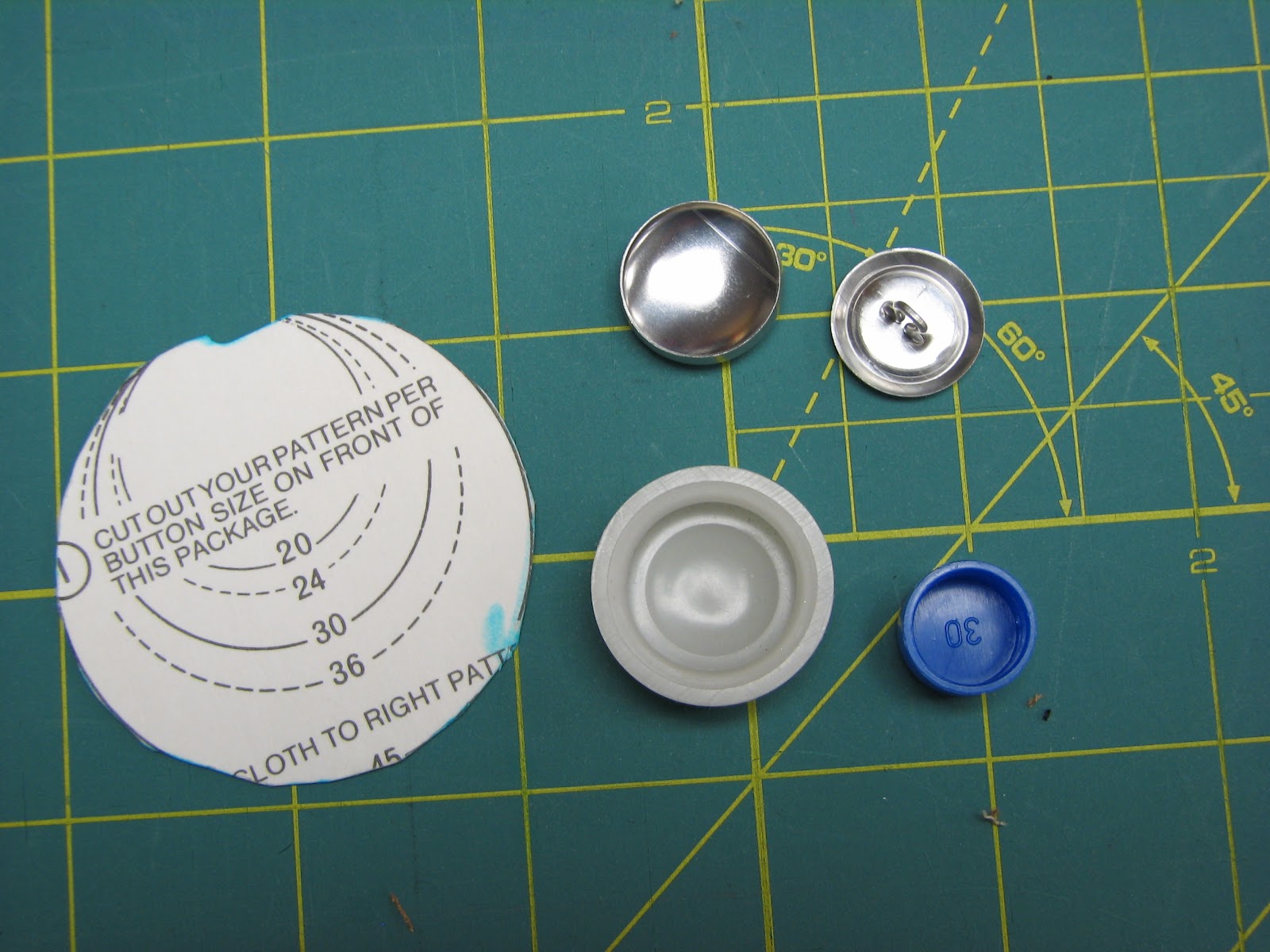

The kit comes with the two-part button (back and shell) and the two-part tool (pusher and mold) to put them together. You will cut a circle template from the package. It's really easy to do! 


I purchased a set of plastic circle templates and used those to trace the buttons rather than the cardboard templates (which I wear out).

In either case, you'll select the template that matches the button size and trace your circle. I'm making a monogrammed button to go on a zipper pull.

You'll want to select light/thin weight fabric like cotton quilting fabric; if it's any heavier/thick, you won't be able to press the button back into the button shell. It might help to give the fabric a light spray with starch.


Once you've traced your circle, grab the button shell and the mold.


Center the fabric (wrong side up) in the mold. Push the button shell in the mold. Work the fabric in - this is why you don't want thick fabric.
Place the back on top of the fabric that's all scrunched in there.


Place the pusher on top and push down. You'll hear the back click into place.


Pop the button out of the mold. If the back is a little off-center, you can pry it off and try again.


Here's what they look like when they are done. I love the monogrammed buttons - I attach them to a jump ring (found in the jewelry making supplies) and use them as zipper pulls!


Want to learn more? Head on over to LollyChops for a detailed tutorial and some more ideas!

Monday, February 20, 2012

Learn to Sew: Making Fringe and Tassels


My homemade fringe maker.
Several years ago, I tried a technique in Linda Lee's book, "Sewing Edges and Corners." It was magic - I made my own fringe from yarn and ribbon. I rigged up a frame from dowels and wood (yes, I'm the daughter of a carpenter!) and went to town. I wrapped the ribbon and yarn around the dowels, and wrapped and wrapped and wrapped some more. Then I used some Seams Great to sew it all together. Viola! AWESOME fringe! But it was a bit difficult and time-consuming.


So when I opened my studio, I had a problem: I didn't want to make frames for my sewing students, so what could I do? Well...I didn't need to do a thing because someone else had a BETTER IDEA and now you can buy your very own fringe maker from My Own Fringe Maker!


Has anyone tried it? It's a bit pricey, but the fringe is incredible!

Monday, January 23, 2012

Lovely Labels

I'm a big fan of labels - they identify you as the maker and show the world what you've created. Personalized labels also may an item look professional!

I purchased my satin labels online at Heirloom Woven Labels. But I've found some at All Things Labels and Namemaker.

You can also make your own labels. Allyson Hill has a great tutorial.

If you'd like to learn more about lovely labels, go to Sew4Home. They have some wonderful examples so you can see exactly what is available to you!

Thursday, January 19, 2012

Our Feet Don't Wear Shoes: Piping Foot

When you want to add piping, you can use a narrow zipper foot, but I prefer the Piping Foot. There is a groove in the bottom the sits directly over the piping! YAY! I've used the Bernina Foot #12 - Janome Piping Foot - and Husqvarna Viking Piping Foot

To learn more about piping, go to Sew4Home and check out the awesome tutorial at the Fabric.com Blog.

See this foot in action below!


Related Posts Plugin for WordPress, Blogger...